The Man Who Sold His Well – Akbar Birbal Story for Kids
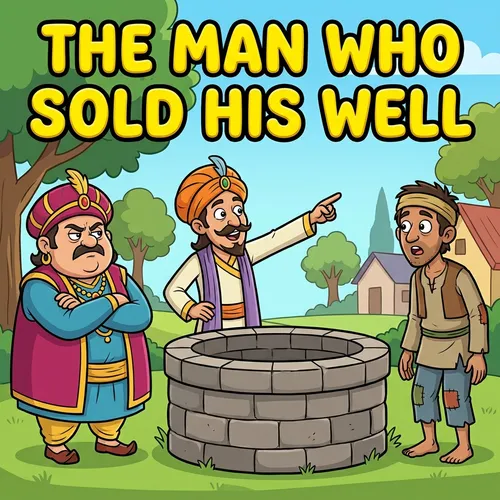
In the magnificent kingdom of Emperor Akbar, where justice was as common as the air people breathed, there lived a simple and hardworking farmer named Gopal. Gopal was a man of the earth, spending his days toiling in the fields under the hot sun. However, he faced a great problem: his land was parched, and he desperately needed a reliable source of water for his crops.
His neighbor, on the other hand, was a wealthy merchant named Sethji. Sethji was known throughout the village not for his kindness, but for his cunning and greed. He owned a deep, stone-lined well that was always full of cool, sweet water. Seeing Gopal’s struggle, Sethji offered to sell him the well.
“I will sell you the well, Gopal,” Sethji said with a sly smile, “but it will cost you a hefty sum of silver coins.”
Gopal, desperate to save his harvest, gathered all his life’s savings. He sold some of his cattle and borrowed money from his relatives. Finally, with a heavy bag of coins, he went to Sethji and bought the well. He returned home happy that night, thinking his troubles were finally over.
The next morning, the sun rose bright and early. Gopal walked to the well with a bucket, whistling a happy tune, ready to water his thirsty crops. But as he lowered his bucket, a hand grabbed his arm. It was Sethji.
“Stop!” shouted Sethji. “What do you think you are doing?”
“I am drawing water from my well,” Gopal replied, confused. “I bought it from you yesterday.”
Sethji laughed, a cold and cruel sound. “You foolish man! I sold you the well, the structure of stones and mud. I did not sell you the water inside it! The water still belongs to me. If you want to take my water, you must pay for every bucket!”
Gopal was stunned. He was a simple man and did not know how to argue with such tricky logic. “But… but a well is useless without water!” he stammered. “When you sell a well, the water is included!”
“Read the contract,” sneered Sethji. “It says ‘The Well’. It does not say ‘The Water’.”
Devastated and cheated, poor Gopal went to the court of Emperor Akbar. He fell at the Emperor’s feet and cried, “Jahanpanah! I have been cheated! I bought a well, but I am not allowed to drink from it!”
Akbar listened to the strange complaint. He stroked his beard and looked at his ministers. “This is indeed a peculiar case,” he mused. “How can one own a well but not the water?” He turned to his wisest minister. “Birbal, only you can solve this riddle.”
Birbal stepped forward, his eyes twinkling with intelligence. He summoned Sethji to the court. The greedy merchant arrived, looking confident and arrogant.
“Is it true that you sold the well to this farmer?” asked Birbal calmly.
“Yes, My Lord,” replied Sethji bowing. “I sold him the well for a fair price.”
“And is it true that you are refusing to let him take water?”
“Absolutely,” said Sethji. “I am a businessman, My Lord. I sold him the well structure. I kept the water for myself. Is it a crime to keep one’s own property?”
The court fell silent. Sethji’s logic, though evil, seemed legally sound. But Birbal simply smiled.
“I see,” said Birbal. “You are indeed a very clever man, Sethji. Your logic is perfect.”
Sethji puffed out his chest. “Thank you, My Lord.”
“However,” Birbal continued, leaning forward, “there is a small problem. Since you admitted that the well belongs to Gopal, and the water belongs to you… why are you keeping your water in his well?”
Sethji’s smile froze.
“You have no right to store your property on Gopal’s land without his permission,” Birbal declared, his voice rising. “You are illegally occupying his well with your water!”
Birbal turned to the Emperor. “Your Majesty, I propose a solution. Since Sethji is using Gopal’s well to store his water, he must pay Gopal a monthly rent of 100 gold coins. Or, he must remove all his water from the well immediately, leaving the well empty for Gopal to use as he pleases.”
Sethji turned pale. Remove all the water? That was impossible! And paying rent would cost him more than the well was worth. He realized he had been trapped in his own web of words.
Trembling, Sethji fell at Akbar’s feet. “Forgive me, Your Majesty! Forgive me, Birbal! I was greedy. I tried to cheat a poor man. I accept that the water belongs to the well owner.”
Akbar fined the merchant for his dishonesty and gave the money to Gopal. The happy farmer returned to his village, and from that day on, no one dared to trick him again.
Moral of the Story: Cleverness without honesty is like a bow without a string. True wit always serves justice.
More Stories You'll Love
Birbal's Khichdi – Akbar Birbal Story for Kids
A classic story of Akbar and Birbal that teaches the value of fairness and the warmth of hope This is a delightful story for kids with a valuable life lesson.

Birbal and the Mother Tongue – Akbar Birbal Story for Kids
A traveling scholar challenges King Akbar's court to guess his true mother tongue. Birbal uses a clever midnight trick to find out the truth!

Birbal and the Magic Sticks – Akbar Birbal Story for Kids
When a wealthy merchant's house is robbed, Birbal hands the suspects "magic" sticks that will catch the guilty thief. A story about cleverness and guilt.
Reactions & Comments
Let us know what you think with a reaction!