The Midas Touch – Moral Story for Kids

Once upon a time, in the land of ancient Greece, lived a rich King named Midas. He had a magnificent castle, beautiful gardens with roses that smelled like perfume, and a lovely daughter named Marigold who was the light of his life. But King Midas had a flaw. He loved gold. He loved it more than his flower garden. He loved it more than his castle. He spent hours in his treasury counting his gold coins. “One, two, three…” he would count. “If only I had more! If only the whole world were made of gold.”
One day, while walking in his garden, Midas found a Satyr (a nature spirit) named Silenus sleeping under a rose bush. Midas was kind to him and helped him find his way back to his master, the god Dionysus. Dionysus was pleased. “Ask for any wish, King Midas,” said the God, “and I shall grant it.” Midas’s eyes lit up. He didn’t ask for health or happiness. He said, “I wish that everything I touch turns to solid gold.” Dionysus frowned. “That is a dangerous wish, King. Are you sure?” “Positive!” said Midas. “I would be the happiest man alive!” “Very well,” said Dionysus. “Tomorrow at sunrise, your wish will come true.”
The next morning, Midas woke up as the sun streamed through the window. He touched his blanket. Ping! It turned into soft, spun gold. He was delighted! He touched his wooden chair. Ping! It became solid gold. He ran through the garden touching roses. Each red flower turned into a hard, yellow, golden flower. They lost their sweet smell, but Midas didn’t care. “I am rich!” he laughed.
After a while, Midas felt hungry. He went to the breakfast table. He picked up a slice of soft bread. Clunk. It turned into a hard slab of gold. He tried to take a sip of water. Clink. The water turned to liquid gold and choked him. Midas became scared. “I am hungry and thirsty,” he cried. “I cannot eat gold!”
Just then, his daughter Marigold came running into the room. “Father!” she called. “Look at the roses! They are all stiff and ugly!” “Don’t cry,” said Midas, reaching out to comfort her. “They are gold!” He touched her shoulder. The most terrible thing happened. The color drained from her cheeks. Her soft hair became hard metal. In an instant, his beautiful, laughing daughter turned into a cold, silent, golden statue. Midas screamed in horror. He fell to his knees. “Marigold! Oh, what have I done? I would give all the gold in the world to have you back!”
He wept and prayed to Dionysus. “Please! Take away this curse! I don’t want the gold anymore!” Dionysus appeared, looking solemn. “Do you see now, Midas? Gold is not the most important thing.” “I see! I see!” sobbed Midas. “Go to the river Pactolus,” instructed Dionysus. “Wash your hands in its water, and the magic will wash away.”
Midas ran to the river. He plunged his hands into the cool water. Golden flakes swirled away in the current. He filled a pitcher with the river water and ran back to the palace. He sprinkled water on the bread—it became soft again. He sprinkled water on the roses—they turned red and fragrant. Finally, with trembling hands, he sprinkled water on his daughter. Marigold blinked. “Father?” she asked. “Why are you crying?” Midas hugged her tightly, tears of joy running down his face. “I am crying because I am the richest man in the world,” he whispered. “Not because of gold, but because I have you.”
Moral of the Story: Greed can make you lose what is truly precious. Family and love are more valuable than all the gold in the world.
Moral of the Story: Greed will not bring happiness; cherish what truly matters.
More Stories You'll Love

Belling the Cat – Aesop Fable for Kids
A group of mice hold a council to solve the problem of a dangerous cat, but realize that having a good idea is different from actually doing it This is a delightful story for kids with a valuable life lesson.
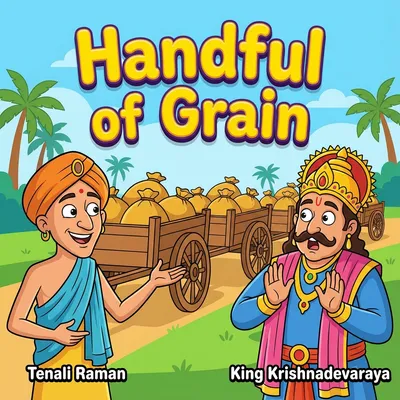
Handful of Grain – Tenali Raman Story for Kids
Tenali solves a complex puzzle using just a handful of grain This is a delightful story for kids with a valuable life lesson.
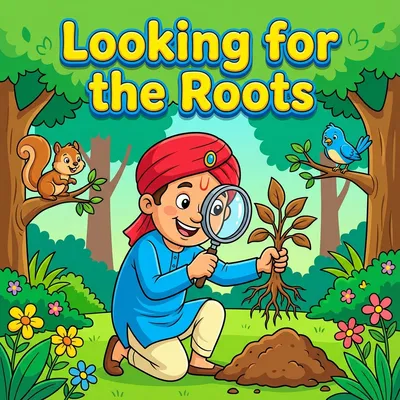
Looking for the Roots – Tenali Raman Story for Kids
Tenali proves his point by pulling at the roots of a problem This is a delightful story for kids with a valuable life lesson.
Reactions & Comments
Let us know what you think with a reaction!